
Building Better Schools: How Illinois Public School Districts Fund Facility Projects
Illinois School Projects: Where Does Funding Come From?
Every school building tells a story. Some tell stories of growth, innovation, and community pride. Others tell stories of aging roofs, outdated mechanical systems, crowded classrooms, accessibility challenges, and long-delayed repairs. In Illinois, public schools are asked to provide safe, welcoming, and effective learning environments for students and faculty while navigating a complicated funding system that often makes facility projects difficult to plan, approve, and complete.
Illinois has thousands of public schools spread across hundreds of districts. According to Ballotpedia, Illinois had 3,977 public schools in 853 districts as of 2022. These schools are publicly funded through a combination of local, state, and federal resources, but those dollars are not set aside solely for buildings. They must cover instruction, staffing, transportation, special education, nutrition, technology, operations, pensions, and countless other obligations before a district can determine what is available for maintenance, renovation, replacement, or new construction.
This article is meant to be a practical overview, not a complete legal or financial guide to every possible funding mechanism. Districts may use other tools—such as bond issues, working cash or life-safety funds, local reserves, private donations, school foundations, special grants, energy-efficiency programs, intergovernmental partnerships, and voter-approved referendums—to help pay for projects. However, the funding sources discussed below are among the most common, accessible, and relevant options for understanding how Illinois school facility projects typically move from need to reality.
Local Funding: The Foundation—and the Pressure Point
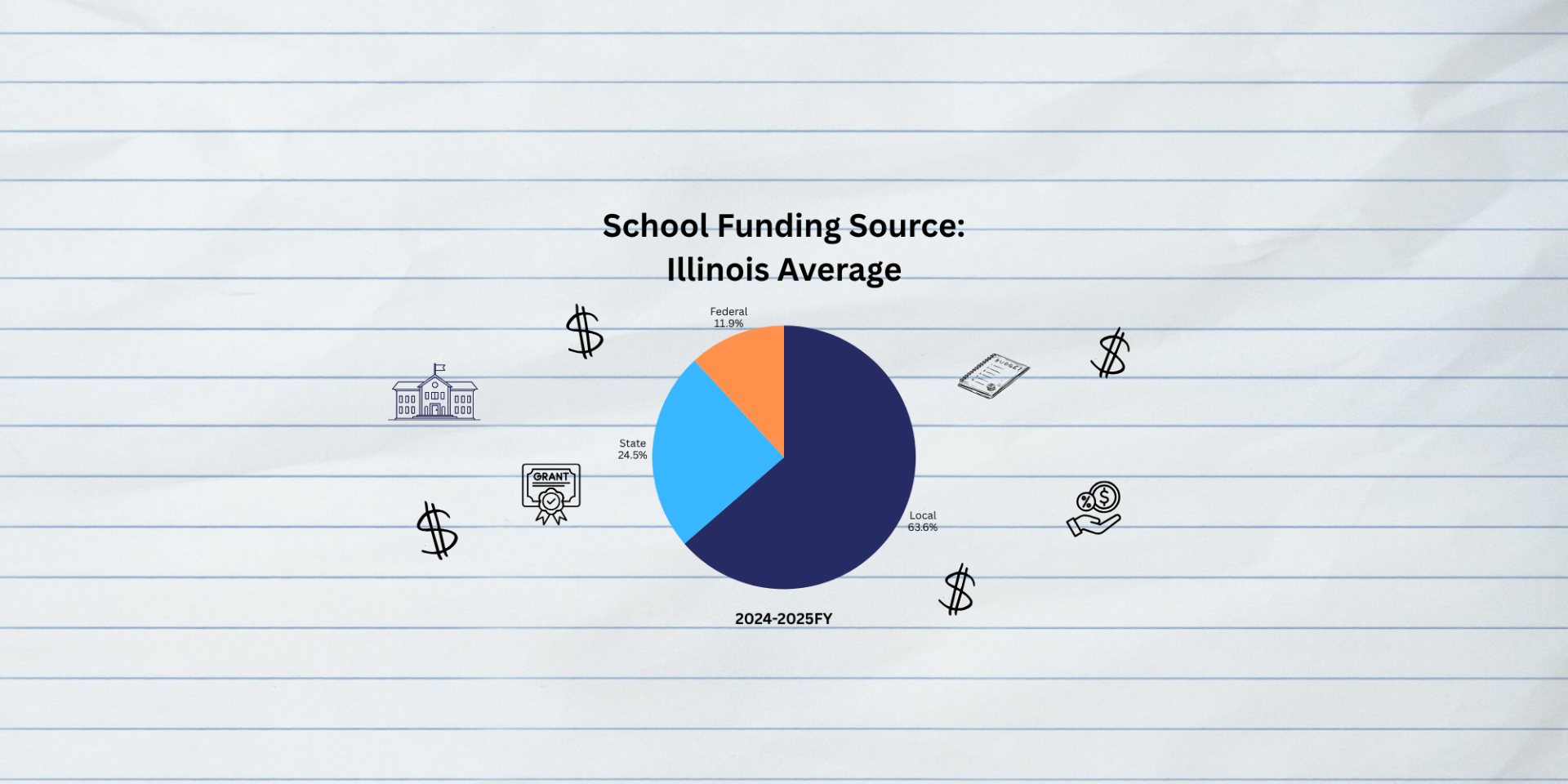
Local revenue is the largest source of school funding for most Illinois districts. The Illinois Report Card explains that local funds come primarily from property taxes, while state and federal funds vary by formula, program, and student need. Recent statewide data also shows Illinois public schools rely heavily on local sources compared with many other states; Illinois report card reported that in the 2024–2025 school year, approximately 63.7% of Illinois public school revenue came from local sources, 24.5% from state sources, and 11.9% from federal sources.
This reliance on property taxes creates a structural challenge. Districts with stronger property tax bases may have more capacity to fund improvements, while property-poor districts may struggle to keep up with basic building needs. The Civic Federation has noted that property taxes are especially important for funding public education, but also politically sensitive and difficult for taxpayers when bills rise faster than household income. For school districts, the result is a constant balancing act: maintain facilities responsibly without overburdening local residents.
The County School Facility Occupation Tax
One local funding tool available in most Illinois counties is the County School Facility Occupation Tax. It should not be viewed as the only answer to school facility funding, but it is one of the clearest examples of a dedicated revenue source specifically tied to buildings and capital improvements. The Illinois Department of Revenue describes this as a countywide sales tax that may be imposed, except in Cook County, to generate revenue used exclusively for school facility purposes. The tax requires voter approval, may be adopted in one-quarter percent increments, and may not exceed 1%.
The process itself shows one of the “hoops” districts must clear. School boards representing more than 50% of the county’s student enrollment must first support placing the question on the ballot. The Regional Superintendent of Schools then certifies the question to the election authority. Only if a majority of voters approve the measure can the tax be imposed. Once collected, the revenue is distributed among school districts in the county generally based on each district’s share of student enrollment.
For communities considering this tax, it is important to understand what it can and cannot do. It is not a blank check for general school operations. It is intended for facility-related purposes, which can include projects such as new construction, renovations, additions, safety improvements, accessibility upgrades, roof work, mechanical systems, and other capital needs. Certain purchases, including titled or registered items such as vehicles, as well as drugs and medical appliances, are not subject to the tax, according to the Illinois Department of Revenue. This tax cannot be used to pay salaries, support school operations, or be used in any way outside of facility needs.
State Funding and Maintenance Grants
State funding is another major part of the school finance picture. Illinois uses Evidence-Based Funding to direct additional resources to districts based on how close they are to an adequacy target. The Illinois State Board of Education has reported that Evidence-Based Funding has improved the funding floor for under-resourced districts and helped more districts move toward full funding adequacy. Even so, state operating support does not automatically solve every facility problem because the same funding must support many educational and operational priorities.
One state program aimed directly at buildings is the School Maintenance Project Grant. The Illinois State Board of Education describes the SMPG as a dollar-for-dollar matching grant that can provide awards up to $50,000 for maintenance or upkeep of educational buildings and structures. Eligible work may include permanent improvements, repairs, and maintenance, with priority categories such as emergency projects, health/life safety, security, accessibility, and infrastructure needs.
The grant is helpful, but it also illustrates the challenge. A $50,000 grant can make a meaningful difference, especially when paired with local funds, but many facility projects cost far more. A roof replacement, HVAC upgrade, secure entrance, boiler replacement, classroom addition, or accessibility renovation can easily exceed the grant maximum. Because the program requires a local dollar-for-dollar match, a district must already have funds available before it can fully benefit from the award.
Federal Funding: Helpful, but Usually Targeted
Federal funding generally represents the smallest share of Illinois school revenue. Federal dollars often support specific programs and student needs, such as Title I, special education, nutrition, preschool, and other targeted services. While federal grants may sometimes support facility-related improvements, they are usually restricted by program rules and are not a dependable, recurring solution for broad capital needs.
Why Facility Projects Are So Difficult to Fund
After identifying local, state, and federal revenue streams, it is tempting to assume facility needs should be easy to solve. In reality, those revenue streams represent the total resources a district receives, not a separate capital fund waiting to be spent. District leaders must account for salaries, benefits, classroom materials, utilities, insurance, transportation, technology, student services, food service, debt obligations, and day-to-day operations before they can address long-term building needs. Other funding avenues may exist, but many require voter approval, competitive applications, matching funds, debt capacity, or years of planning.
This is why school facility work often happens in phases. A district may replace a roof one section at a time, postpone an HVAC upgrade, patch a parking lot instead of reconstructing it, or prioritize the most urgent life-safety items while less visible needs wait. The building may still open every morning, but that does not mean the facility is where it should be. Students and teachers may spend years working around aging systems, inefficient layouts, temperature issues, limited accessibility, or spaces that no longer support modern learning.
The planning process itself can also be lengthy. Before construction begins, a district may need facility assessments, cost estimates, board approvals, community engagement, ballot questions, grant applications, matching funds, design services, bidding, permitting, and coordination with architects, engineers, contractors, and code officials. Each step is necessary for responsible public spending, but each step also takes time. For smaller districts with limited administrative staff and limited reserves, the process can feel especially daunting.
Why the County Facility Tax Can Matter
For counties where the County School Facility Occupation Tax is on the ballot, voters are often asked to weigh a direct cost against a community benefit. This article is not meant to suggest that the tax is the only available path for school improvements. Rather, it is one practical tool that can be especially helpful because the revenue is dedicated to school facilities and distributed countywide. That means districts may be able to plan more responsibly, address deferred maintenance sooner, reduce reliance on property taxes or debt in some cases, and create safer, more functional buildings for students, teachers, and staff.
This type of funding can be especially important for architecture, engineering, and construction projects because capital improvements require predictable resources. A district cannot responsibly design a building addition, replace major mechanical systems, or plan a security upgrade without knowing how the project will be paid for. Dedicated facility revenue gives districts a tool to move from reacting to emergencies toward planning long-term improvements.
Supporting a facility tax is not about ignoring the burden taxpayers already carry. It is about recognizing that school buildings are public infrastructure. They serve children, educators, families, extracurricular programs, emergency shelters, community meetings, and local pride. When communities invest in safe, accessible, efficient, and well-maintained schools, they are investing in the daily environment where students learn and staff work.
Conclusion
Illinois school facility projects are funded through a patchwork of property taxes, state formulas, targeted grants, federal programs, voter-approved revenue, local reserves, bond tools, and careful budgeting. There are more funding methods than can be covered in one short article, and each district’s situation is different. The goal here is to explain the most common and accessible pathways in a way that helps residents understand why even obvious needs—safe entrances, reliable HVAC, accessible restrooms, repaired roofs, modern classrooms—can take years to fund and complete.
School districts do not pursue capital projects because they are convenient. They pursue them because students and faculty deserve safe, healthy, and functional places to learn and work. When a county has the opportunity to consider a dedicated school facility tax, the question is not simply whether residents want another tax. The deeper question is whether the community wants to give its schools a practical, dedicated tool to maintain and improve the buildings that serve the next generation.
Sources
- Illinois Department of Revenue. “County School Facility Occupation Tax.” https://tax.illinois.gov/localgovernments/localtaxallocation/taxes-distributed-to-local-governments/county-school-facility-occupation-tax.html
- Civic Federation. “School Districts and Property Taxes in Illinois.” https://www.civicfed.org/civic-federation/blog/school-districts-and-property-taxes-illinois
- Illinois Report Card. “Per Student Spending / District Finance Data.” https://www.illinoisreportcard.com/State.aspx?source=environment&source2=perstudentspending&Stateid=IL
- “Public Education in Illinois.” https://ballotpedia.org/Public_education_in_Illinois
- Taxpayers’ Federation of Illinois. “Illinois School Funding: Property Tax Reliance Down, but New Demands for State Funds Loom.” https://illinoistax.org/?p=2476
- Illinois State Board of Education. “School Maintenance Project Grant.” https://www.isbe.net/Pages/School-Maintenance-Project-Grant.aspx
- Education Law Center. “Illinois School Funding.” https://edlawcenter.org/research/illinois/
- Regional Office of Education #21. “County School Facility Occupation Tax (CSFOT).” https://www.roe21.org/about/reports/county-school-facility-occupation-tax/